Contextual Structures
Context in RAMEN distinguishes content-bearing objects from the contextual structures that give them an editorial role. A Content node carries material, such as text or image data; a Collection node describes the context in which that material is understood. The same text may therefore belong to different witnesses, letters, corpora, or other project-specific structures.
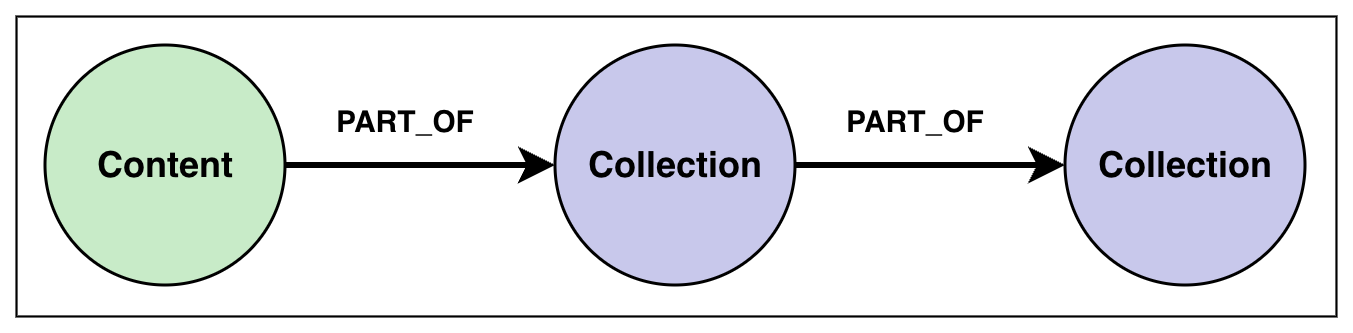
This is modelled through PART_OF relations. Content can be PART_OF a collection, and collections can be PART_OF larger collections. RAMEN can therefore describe different editorial contexts for the same content.
Collection Nodes
Collection nodes represent contextual structures. They describe how parts of an edition are grouped, arranged, or interpreted as belonging together. A Content node may contain only plain text or image data, while a Collection defines what this content is within the project.
Through PART_OF relations, collections can contain other collections as well as content-bearing nodes, allowing projects to build larger contextual structures from smaller ones. Collections are not only containers: they can also be annotated through HAS_ANNOTATION and referred to by annotations through REFERS_TO, making them objects of editorial interpretation.
When the order of items in a collection is part of the editorial interpretation, it can be represented in different ways depending on the project model. One option is an Annotation node: the collection HAS_ANNOTATION the ordering annotation, and the annotation REFERS_TO the items whose sequence is being described.
More detailed models may introduce custom implementations or use several connected annotations.
The PART_OF Relation
PART_OF is the central relation for contextual structures. It organises collections into larger collections and relates content-bearing nodes to the collections in which they are understood. In project models, allowed PART_OF relations are defined explicitly: not every collection can automatically be part of every other collection.
This allows projects to model contextual structures with clear rules. A project may define, for example, that a Text is PART_OF a Witness, and that a Witness is PART_OF a Letter. If another relation is needed, it has to be part of the project model.
Examples of Contextual Structures
The following examples show how Collection and PART_OF can model different forms of editorial organisation.
The following examples are not intended as best practices. They illustrate possible ways of modelling structures. Project models depend on material, research questions, workflows, and requirements, and they evolve as a project develops.
The examples below describe model concepts, not individual data records. A project model may define a collection type such as Corpus; the actual data may then contain a specific corpus titled Correspondence between Person A and B.
Corpus is the model type, while the titled corpus is one concrete instance of that type.
Correspondence
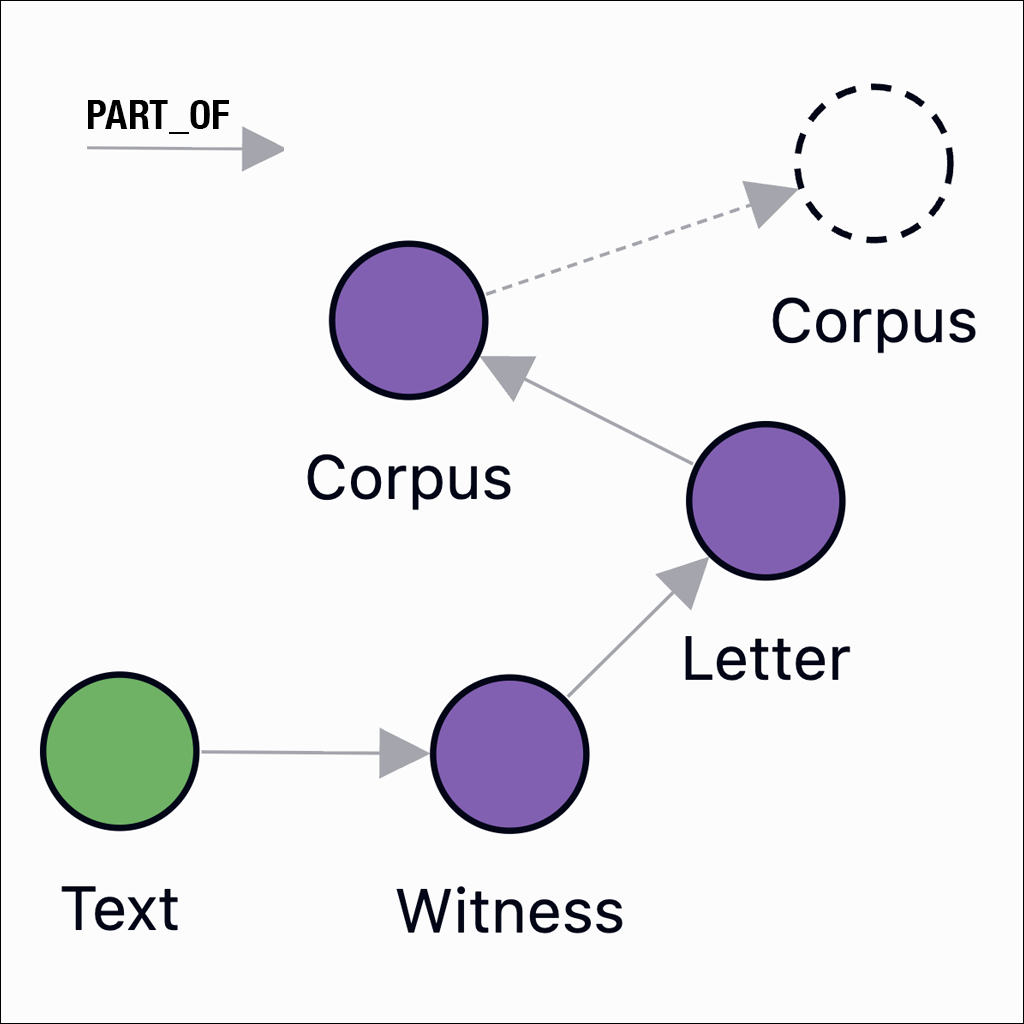
In a correspondence edition, a project may distinguish between a Corpus, a Letter, one or more Witness collections, and the refined Content node Text, which carries the plain text of the transcription. Through PART_OF, the Text can be understood as the text of a specific Witness, the Witness as part of a Letter, and the Letter as part of a Corpus.
A Corpus can also be used at different contextual levels. For example, one Corpus may represent the correspondence between two persons, while another Corpus may represent the broader collection of all correspondence edited by the project.
Regesta
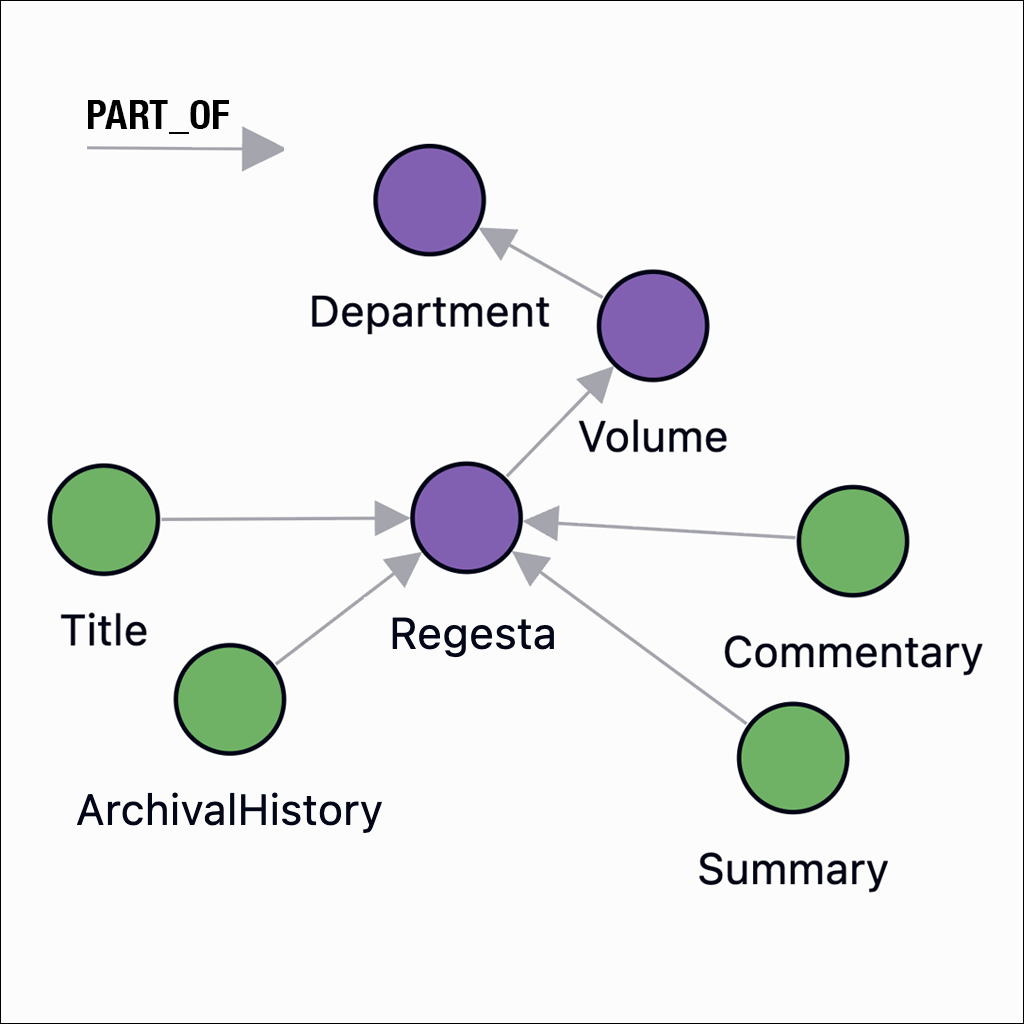
In a regesta project, a project model may distinguish between a Regesta, refined Content nodes such as Title, Summary, Commentary, or ArchivalNote, and larger contextual structures such as a Volume or Department.
The Regesta is a Collection node. It brings together these separate content-bearing nodes as one contextualised editorial object. Through PART_OF, each refined Content node can be related to one Regesta.
The Regesta can then be related to larger Collection nodes, such as a Volume or Department. This makes it possible to capture the textual parts separately while still modelling them as one regest within a broader editorial or archival structure.
Books of Fortune
Books of fortune are non-linear and interactive texts. Instead of being read from beginning to end, they guide readers through questions, randomising mechanisms, thematic sections, authorities, and possible game paths (cf. Cugliana et al. 2024).
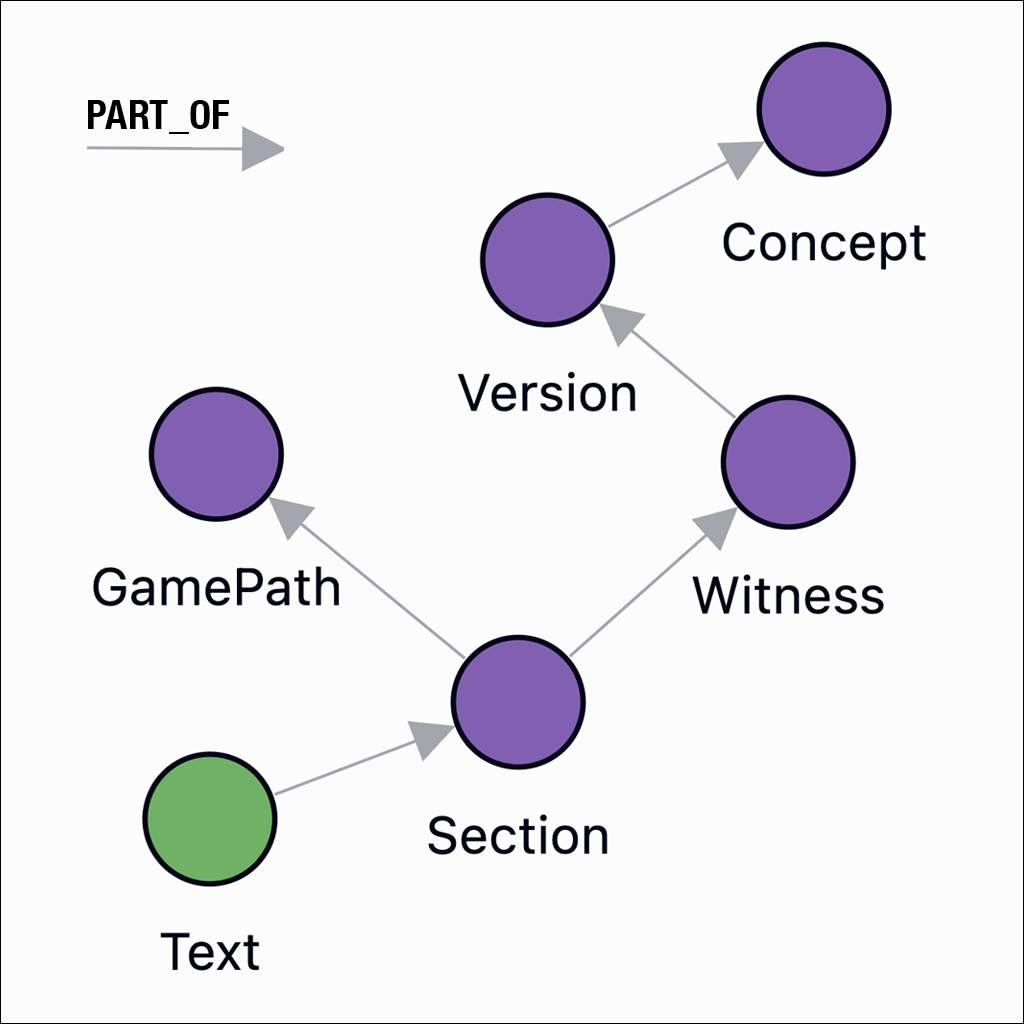
A project model may distinguish here between different refined Collection nodes. Concept nodes can describe larger structural components of the text, Version and Witness nodes the transmission context, and Section nodes the internal organisation of a witness. Text nodes are refined Content nodes that carry the actual textual content.
A GamePath could be modelled as a separate Collection. It brings together the text parts that belong to one possible reading path through the book, for example from a question to an answer.
This makes it possible to describe the same material in two ways: as part of a witness and as part of an interactive path.