Modelling Knowledge
Knowledge in RAMEN describes how editorial information is made explicit through annotations and connections. An Annotation node contributes to the knowledge structure of the edition whenever it describes, classifies, interprets, or links editorial objects.
RAMEN does not treat knowledge as a separate layer detached from the edition. Knowledge is built through explicit connections between annotations, entities, content, collections, and other annotations. Because RAMEN is close to graph-based knowledge modelling, entities can also be connected to external authority records, knowledge graphs, datasets, or other resources.
A central part of this knowledge concerns identifiable objects of scholarly interest, such as persons, places, works, institutions, events, or concepts. In RAMEN, these objects can be represented as Entity nodes.
Entity Nodes
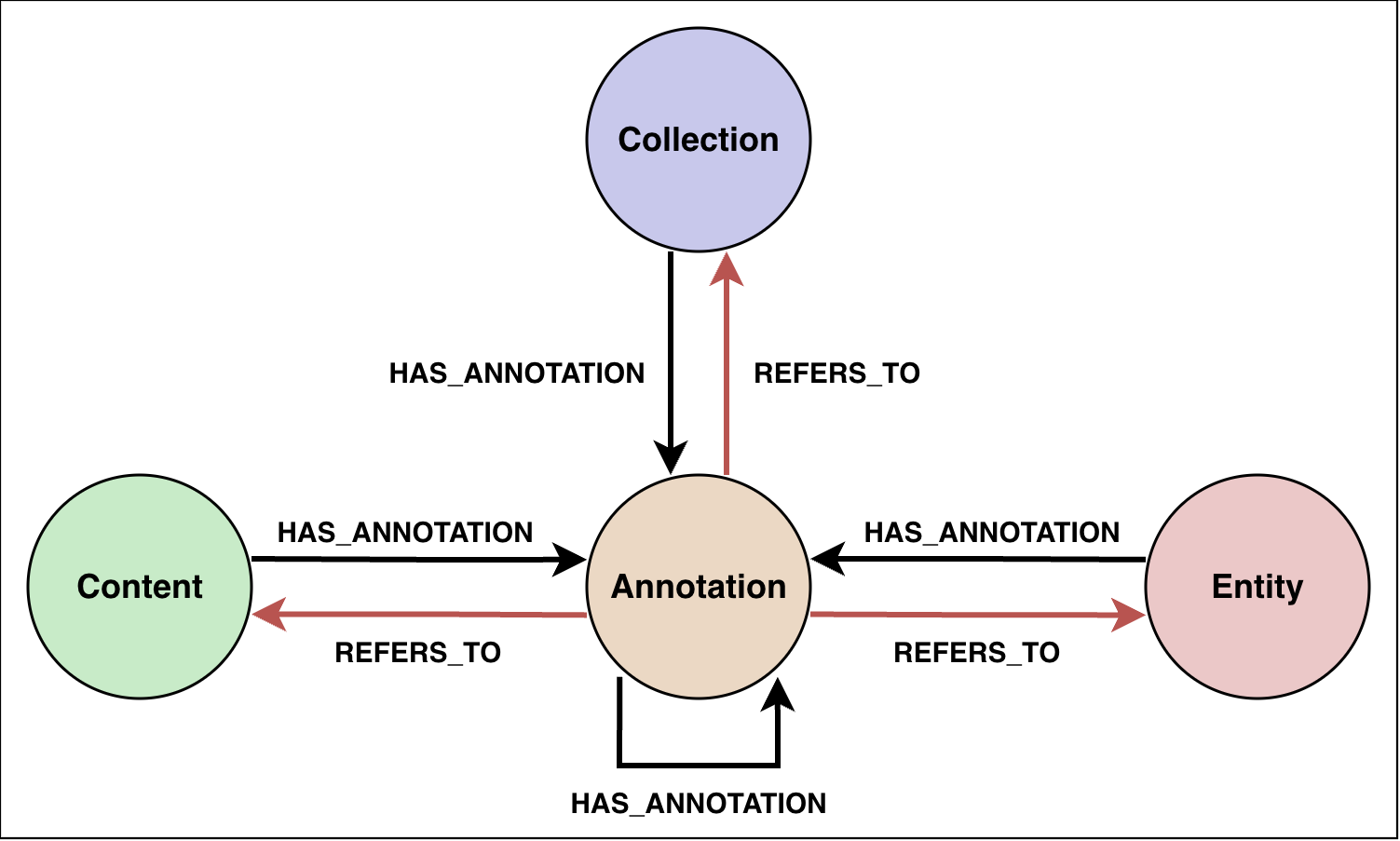
Entity nodes represent identifiable objects of scholarly interest. A refined Entity node may, for example, be called Person, Place, Work, Institution, Event, or Concept, depending on the project model.
Entities can carry attributes, such as names, dates, descriptions, external authority references, or links to knowledge graphs and other resources. They can also be annotated through HAS_ANNOTATION, which makes it possible to add editorial statements about an entity without changing the entity itself.
The REFERS_TO Relation
REFERS_TO is used when an Annotation points to the editorial object that its statement is about. This target may be an Entity, but it may also be a Content node or a Collection.
Annotation nodes are one of the main mechanisms for making editorial knowledge explicit. Through HAS_ANNOTATION, an annotation is attached to the object being annotated; through REFERS_TO, it connects this statement to the object it refers to.
This makes it possible to model knowledge as explicit editorial statements rather than as direct, unqualified links.
Annotation nodes themselves can also be annotated through HAS_ANNOTATION. This makes it possible to qualify or comment on statements, for example by adding information about certainty, source, responsibility or interpretation, without making annotations targets of REFERS_TO.
Connecting Authority Data
External authority providers such as the GND or Wikidata can be connected to RAMEN entities implicitly by referencing identifiers or URIs, for example through entity attributes or annotations.
For workflows that connect several databases while keeping their data holdings separate, see NAKAR.
Examples of Modelling Knowledge
The following examples show how annotations, entities, and references to other editorial objects can be used.
The examples below describe knowledge-modelling patterns. They are not intended as best practices, but illustrate possible modelling choices that may differ between projects and tools.
Named Entity Connections
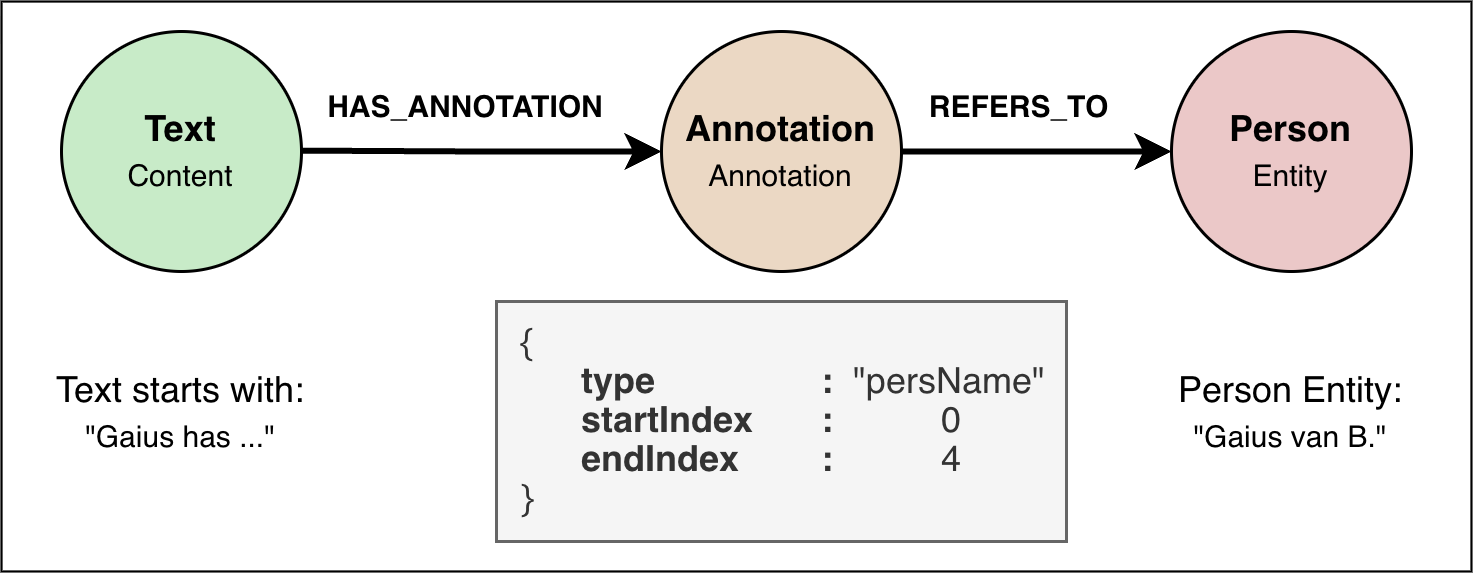
A common knowledge-modelling pattern is to connect a text passage to an identifiable entity. A refined Content node, such as Text, can HAS_ANNOTATION an Annotation with type: "persName". This annotation can then REFERS_TO a Person entity.
In this pattern, the textual occurrence and the identified person remain separate. The text contains the written form, the annotation describes the occurrence, and the entity represents the person as an independent knowledge object.
Entity Connections
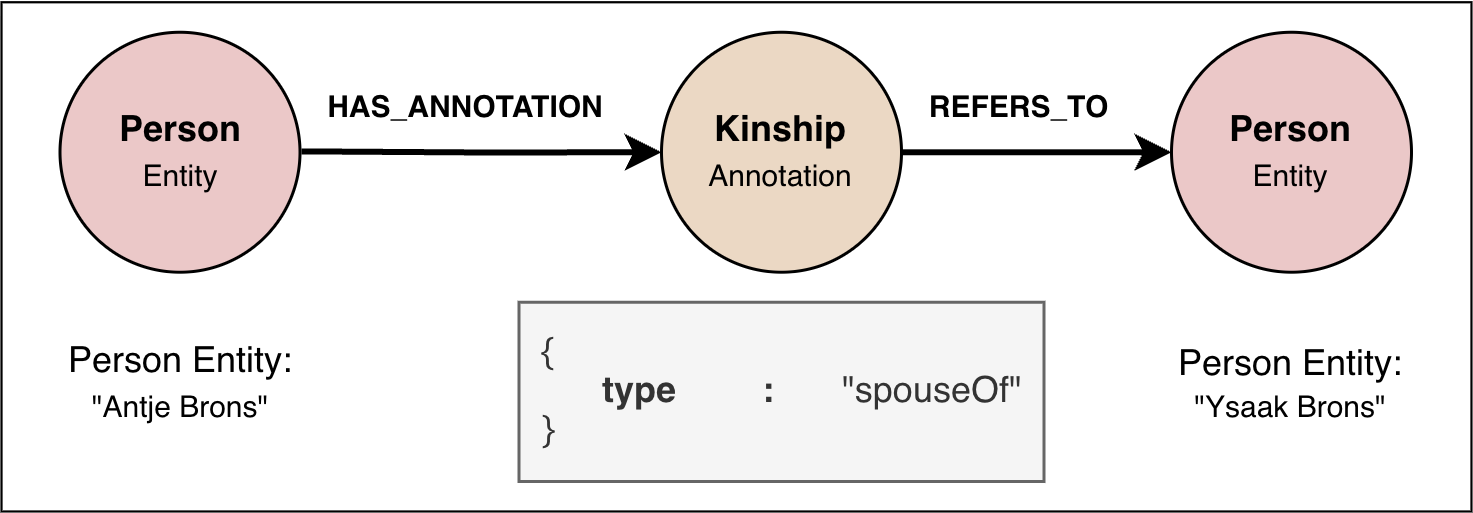
Knowledge can also be modelled between entities. For example, a Person entity may HAS_ANNOTATION a refined Annotation node such as Kinship, and this annotation may REFERS_TO another Person entity.
This makes the connection itself explicit, editable, and annotatable. The statement is not only a direct edge between two persons; it can carry its own type, attributes, sources, uncertainty, commentary, or further annotations if the project model requires it. In this example, Kinship is a project-specific refinement of Annotation, while type: "spouseOf" describes the kind of kinship.